
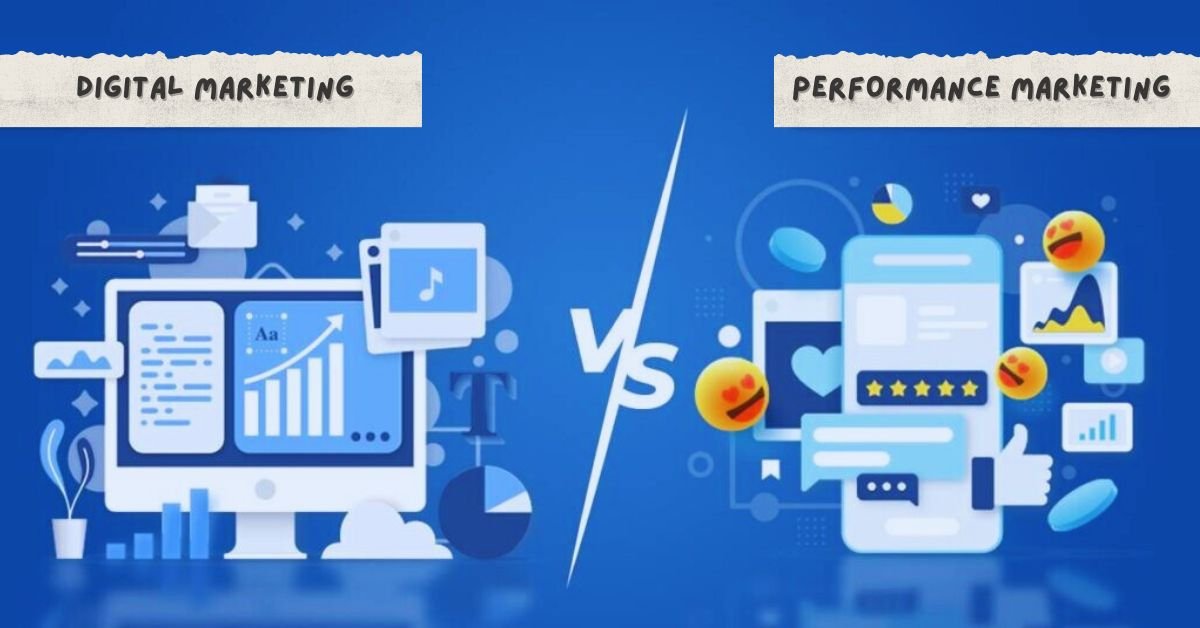
Understanding performance marketing vs digital marketing is essential for students, beginners, and business owners who want clear insight into how modern online marketing actually works. Many people think both terms mean the same thing because they rely on digital platforms, but that’s not true. The real difference between digital marketing vs performance marketing lies in their goals, pricing models, timeframes, and how results are measured.
Let’s break down each concept step by step so you can clearly understand how they work and when to use them.
Performance Marketing vs Digital Marketing
The core difference between performance marketing vs digital marketing lies in their purpose, strategy, and payment structure. While both fall under online marketing, they operate with different goals and measurement methods.
Digital marketing is a broad approach that helps businesses promote their brand, increase online visibility, and build long-term relationships with their audience through multiple digital channels. It focuses on creating awareness, trust, and engagement over time rather than immediate results.
Performance marketing, in contrast, is a results-focused model where advertisers pay only when a specific measurable action occurs, such as a click, lead, signup, or sale. This approach prioritizes measurable outcomes, campaign efficiency, and return on investment.
In simple terms:
- Digital marketing builds brand presence and audience trust gradually.
- Performance marketing concentrates on conversions and measurable ROI.
Both strategies are closely connected, but they serve different roles within a complete marketing strategy. Digital marketing creates demand, while performance marketing converts that demand into tangible results.
What Are Digital Marketing and Performance Marketing?
To fully understand the comparison, we must first understand each concept individually.
What Is Digital Marketing?
Digital marketing is the use of online channels to promote products, services, or brands. It includes SEO, content marketing, social media marketing, email marketing, search engine marketing (SEM), and online advertising. Businesses use these channels to increase website traffic, generate leads, improve online visibility, and drive conversions. All activities are measurable through data such as traffic, engagement, and conversion rate.
In the discussion of performance marketing vs digital marketing, digital marketing refers to the broader marketing system. It focuses on brand awareness, audience engagement, and long-term growth.
It includes multiple channels and strategies such as:
- Search Engine Optimization (SEO)
- Social Media Marketing
- Email Marketing
- Search Engine Marketing (SEM)
- Content Marketing
- Display Advertising
- Video Marketing
- Mobile Marketing
Digital marketing is not limited to paid advertising. It includes organic methods like SEO and content marketing, as well as paid strategies.
Main Objectives of Digital Marketing
Digital marketing focuses on:
- Increasing brand awareness
- Generating leads
- Driving website traffic
- Improving customer engagement
- Supporting conversions
- Building long-term brand authority
It works across the entire marketing funnel:
- Awareness – Customers discover the brand.
- Consideration – Customers evaluate products or services.
- Conversion – Customers make a purchase or complete an action.
- Retention – Customers return and stay loyal.
Digital marketing is strategic and long-term oriented. It builds trust before asking for a sale.
What Is Performance Marketing?
Performance marketing is a data-driven advertising model where advertisers pay only for measurable results such as clicks, leads, sales, app installs, or registrations. It operates on performance-based pricing models including CPC (cost per click), CPA (cost per acquisition), CPL (cost per lead), and CPS (cost per sale). Campaign success is measured using conversion rate, cost per acquisition, and return on ad spend (ROAS).
In the context of performance marketing vs digital marketing, performance marketing focuses on direct response and revenue generation. It mainly uses paid media channels such as search advertising, paid social media ads, display advertising, and affiliate marketing. Campaigns are tracked in real time and optimized to improve conversion performance and maximize ROI.
These outcomes include:
- Clicks
- Leads
- Sales
- App installs
- Sign-ups
Unlike general digital marketing, performance marketing is purely results-focused.
Platforms Used in Performance Marketing
Performance marketing mainly uses paid platforms such as:
- Google Ads
- Social media ads
- Display or banner advertising
- Affiliate networks
Here, advertisers set a defined budget and optimize campaigns based on data. If a campaign does not perform well, it is adjusted immediately.
Main Objectives of Performance Marketing
-
Generate measurable conversions
-
Maximize return on ad spend (ROAS)
-
Optimize campaigns based on analytics
-
Scale profitable campaigns
It is data-driven and conversion-focused, making it highly accountable.
Digital Marketing Vs Performance Marketing: Strategic Comparison
Let’s compare both approaches clearly.
| Basis | Digital Marketing | Performance Marketing |
|---|---|---|
| Definition | Broad marketing approach using digital channels | Subset of digital marketing focused on measurable actions |
| Goal | Brand awareness + engagement + growth | Direct conversions and measurable results |
| Payment Model | Fixed budget or exposure-based | Pay for results (click, lead, sale) |
| Focus | Long-term brand building | Short-term measurable ROI |
| Metrics | Traffic, engagement, impressions | CPA, ROAS, conversions |
Metrics to Measure Performance Marketing
Performance marketing is easy to measure because it is action-based.
Cost Per Mille (CPM)
CPM refers to the cost for 1,000 ad impressions. It is often used for awareness campaigns within paid advertising.
Cost Per Click (CPC)
CPC measures how much you pay each time someone clicks your ad. Lower CPC combined with high conversion rate improves campaign efficiency.
Cost Per Action (CPA)
CPA calculates the cost when a user completes a specific action such as signing up or purchasing. It directly reflects performance success.
Customer Lifetime Value (LTV)
LTV measures the total expected revenue from a customer over time. It helps businesses decide how much they can afford to spend on acquisition.
These metrics help measure ROI, optimize campaigns, and ensure profitability.
Metrics to Measure Digital Marketing
Digital marketing focuses on broader engagement and audience behavior.
Bounce Rate
Bounce rate shows the percentage of users who leave a website without interacting. A high bounce rate may indicate poor content or targeting issues.
Page Views
Page views measure how many pages users visit. Higher page views often indicate stronger interest and engagement.
Conversion Rate
Conversion rate calculates the percentage of visitors who complete a desired action.
Click-Through Rate (CTR)
CTR measures how attractive your content or advertisement is. It compares total clicks to total impressions.
Digital marketing metrics help evaluate visibility, engagement, and overall brand interaction.
Types of Performance Marketing
Performance marketing uses various result-focused methods.
Search Performance Marketing
Paid search ads appear on search engine result pages targeting high-intent keywords. These ads capture users who are ready to take action.
Social Performance Marketing
Paid social media ads optimized for conversions, targeting users based on interests and behavior.
Email Performance Marketing
Conversion-focused email campaigns measured by open rate, click rate, and sales performance.
Publisher Performance Marketing
Display ads placed on third-party websites or apps to drive traffic and conversions.
Affiliate Performance Marketing
Commission-based marketing where affiliates promote products and earn a commission for each sale.
All these types focus on measurable outcomes and ROI.
Types of Digital Marketing
Digital marketing combines multiple strategies to build long-term brand strength.
Content Marketing
Creating valuable blogs, videos, webinars, and reports to educate and attract audiences.
Search Engine Marketing (SEM)
Includes both paid ads and organic search visibility.
Social Media Marketing
Building engagement and community through organic posts and paid campaigns.
Paid Advertising
Includes PPC (Pay Per Click) and CPM (Cost Per Mille) campaigns for reach and traffic.
Digital marketing integrates organic and paid strategies to support overall growth.
Here are Top 5 searchable FAQs optimized for SEO, user intent, and featured snippet chances for your topic performance marketing vs digital marketing:
Frequently Asked Questions (FAQs)
1. What is the difference between performance marketing vs digital marketing?
The main difference between performance marketing vs digital marketing is their focus. Digital marketing builds brand awareness and long-term growth, while performance marketing focuses on measurable results like leads, sales, or clicks.
2. Is performance marketing part of digital marketing?
Yes, performance marketing is a subset of digital marketing. It is a results-driven approach within digital marketing that emphasizes paid campaigns and measurable outcomes.
3. Which is better: digital marketing or performance marketing?
Neither is better on its own. Digital marketing is ideal for brand building and long-term growth, while performance marketing is best for quick results and ROI tracking. Businesses usually use both together.
4. Can beginners learn performance marketing before digital marketing?
Beginners can learn performance marketing directly, but understanding digital marketing fundamentals first helps build stronger strategy and analytical skills.
5. Why is performance marketing important for businesses?
Performance marketing is important because it allows businesses to track results accurately, control budgets efficiently, and pay only for actions that generate value, such as leads or sales.