
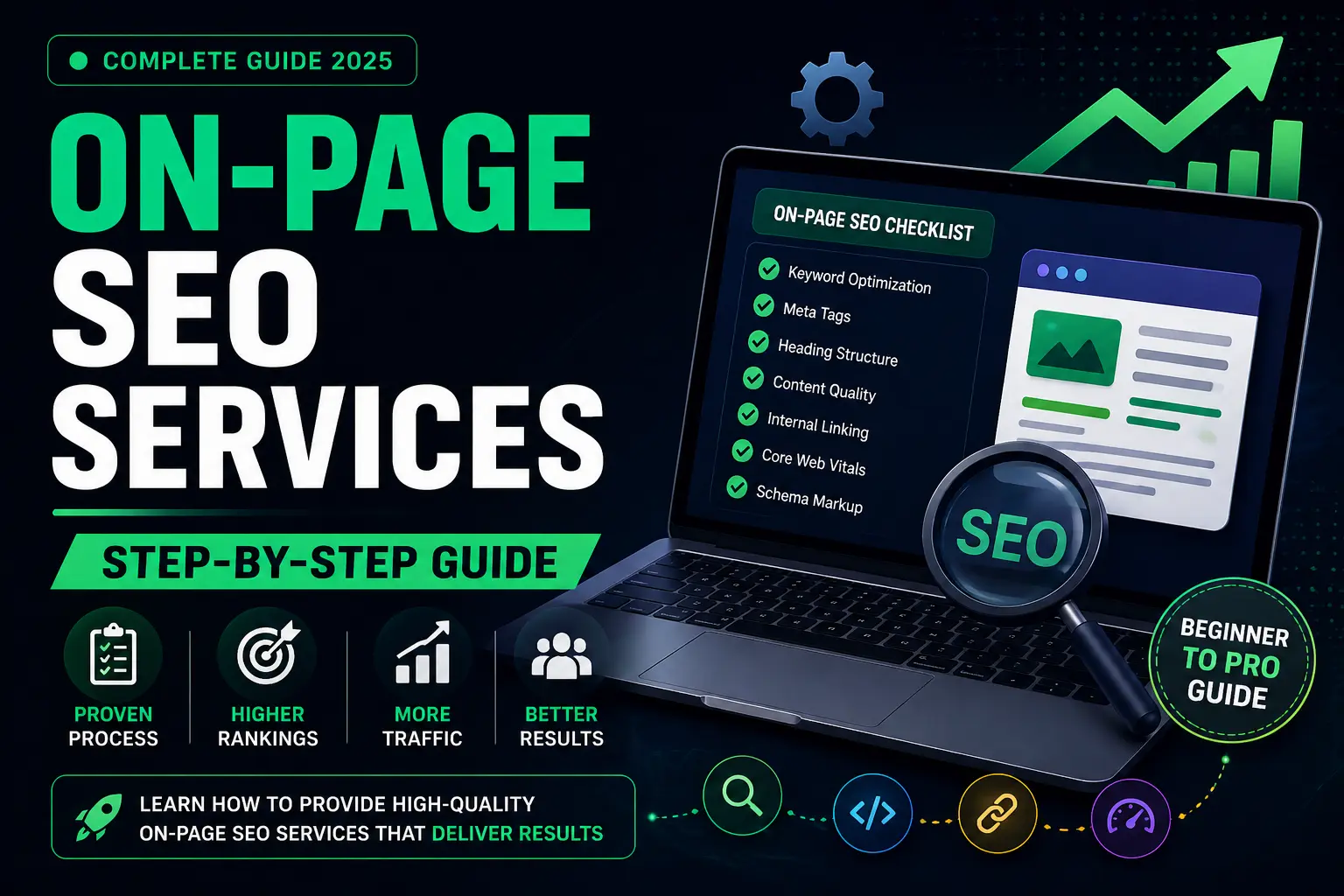
On-page SEO services are the foundation of every successful search strategy. While backlinks and domain authority often steal the spotlight, it is the on-page layer — your titles, content structure, keyword usage, internal links, and technical markup — that tells search engines exactly what your page is about and who it should be shown to. Without getting on-page optimization right, even the strongest link profile will underdeliver.
However, to boost results, you should first understand the complete SEO process and how all its components work together.
If you are an SEO professional, agency, or freelancer looking to deliver on-page SEO services to clients, this guide breaks down every element you need to master — from initial audit to final implementation. Every section is practical, structured for execution, and grounded in what search engines actually reward in 2026.
What Are On-Page SEO Services?
On-page SEO services refer to the set of optimization tasks performed directly on a webpage to improve its relevance, usability, and visibility in search engine results. Unlike off-page SEO — which involves link building, brand mentions, and external signals — on-page SEO is entirely within your control. This makes it the first and most critical step in any SEO engagement.
These services cover a wide spectrum: keyword research and placement, meta tag writing, heading structure, content depth, image optimization, internal linking strategy, URL formatting, structured data implementation, and page speed improvements. Each element communicates a signal to Google’s crawlers and ranking algorithms, and optimizing them in harmony produces compounding results.
When provided as a professional service, on-page SEO typically involves a detailed audit of existing content, a gap analysis against top-ranking competitors, a structured implementation plan, and ongoing tracking. The goal is to align every on-page element with both user intent and search engine requirements simultaneously.
Step 1 — Conduct a Thorough On-Page SEO Audit
Every on-page SEO engagement should begin with a comprehensive audit. This is your diagnostic phase — you are mapping the current state of the website before recommending or implementing any changes. Skipping this step leads to guesswork and misaligned recommendations that fail to move rankings.
A professional on-page audit examines several dimensions: crawlability (can search engines access and index all important pages?), content quality (does existing content match search intent?), keyword usage (are primary and secondary keywords placed in the right locations?), technical markup (are title tags, meta descriptions, and header tags correctly implemented?), and internal linking (does the site pass authority efficiently between related pages?). Tools like Screaming Frog, Ahrefs Site Audit, and Google Search Console are essential here.
What to include in your audit checklist
- Crawl all pages and identify indexation issues, redirect chains, and broken links
- Review title tags and meta descriptions for uniqueness, length, and keyword inclusion
- Analyze heading structure (H1, H2, H3) across key landing pages
- Measure content length against top 5 SERP competitors for each target keyword
- Identify pages with thin content, duplicate content, or keyword cannibalization
- Review internal link distribution using tools like Screaming Frog’s link report
- Check image alt text, file names, and compression status
- Assess Core Web Vitals scores via Google PageSpeed Insights
- Scan for missing or incorrect structured data (schema markup)
- Identify pages with poor click-through rates via Search Console’s Performance report
Step 2 — Keyword Research and Search Intent Mapping
Effective on-page SEO services are built on precise keyword research. The goal is not just to find high-volume keywords but to understand the specific intent behind each search query. Google categorizes intent as informational (the user wants to learn), navigational (the user wants to reach a specific site), commercial (the user is researching before buying), or transactional (the user is ready to act). Matching content type to intent is as important as the keyword itself.
For each page you are optimizing, identify one primary keyword, two to four secondary keywords, and a cluster of LSI (Latent Semantic Indexing) terms. LSI terms are semantically related words and phrases that provide context. For example, if the primary keyword is “on-page SEO services,” related LSI terms would include “website content optimization,” “meta tag setup,” “SEO content audit,” “page-level SEO,” and “search engine ranking factors.” These naturally expand topical coverage and help pages rank for a wider set of queries without keyword stuffing.
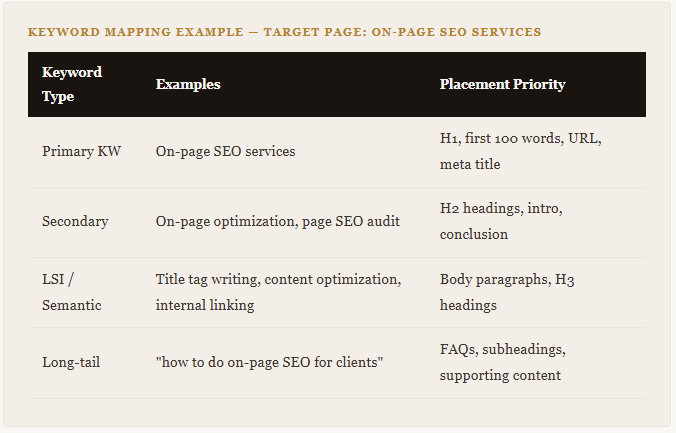
Tools like Ahrefs help identify keyword opportunities and search intent.
Step 3 — Optimize Title Tags and Meta Descriptions
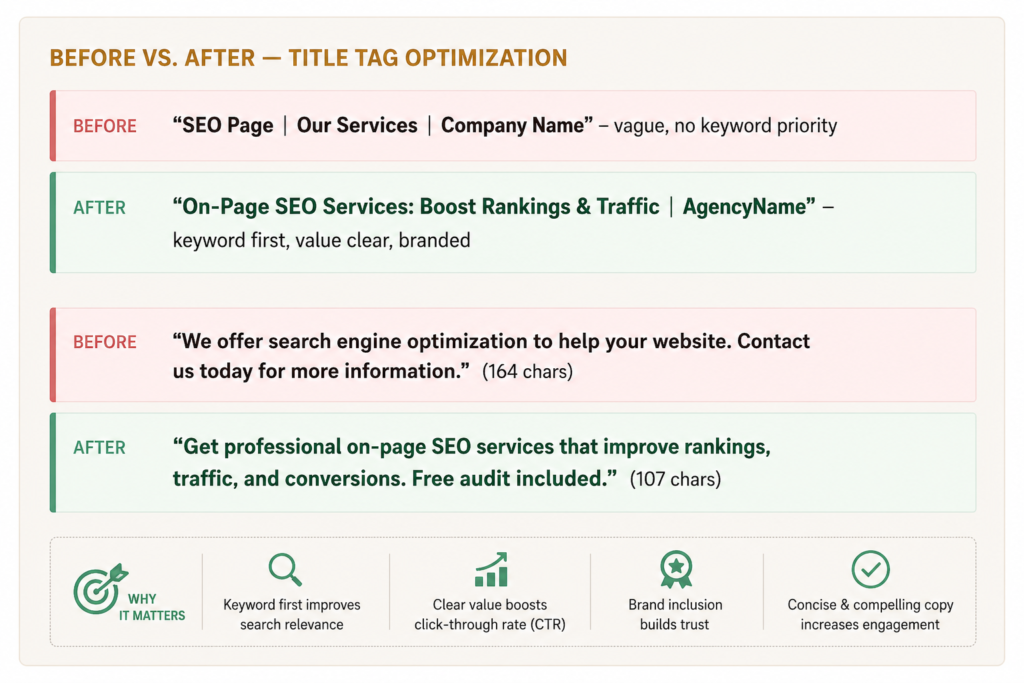
The title tag is the single most important on-page SEO element after content itself. It appears as the clickable headline in search results and is a confirmed ranking factor. Every page you optimize should have a unique, keyword-rich title tag that stays within 55–60 characters to avoid truncation in SERPs. Front-loading the primary keyword — placing it at or near the beginning of the title — increases both relevance signals and click-through rates.
Meta descriptions, while not a direct ranking factor, have a powerful indirect effect on SEO performance through click-through rate (CTR). A well-written meta description that includes the primary keyword naturally (Google bolds it in results when it matches the search query), communicates clear value, and includes a call to action can dramatically increase organic clicks. Keep meta descriptions between 140–160 characters for desktop and 120–130 for mobile optimization.
Title tag optimization formula
Step 4 — Structure Content with Proper Heading Hierarchy
A correct heading structure serves two masters simultaneously: it improves readability for human users and communicates content organization to search engine crawlers. Each page should have exactly one H1 tag containing the primary keyword, multiple H2 headings for major sections (each containing secondary or LSI keywords naturally), and H3 or H4 subheadings for supporting details, examples, and deeper breakdowns. Think of it as a document outline — logical, scannable, and keyword-rich.
One of the most common on-page SEO mistakes is treating headings as purely visual styling choices. In practice, H2 headings signal major subtopics to Google and are frequently used to generate featured snippets, People Also Ask results, and knowledge panel data. When you are providing on-page SEO services, auditing and restructuring heading hierarchies is often one of the highest-impact, lowest-effort improvements you can deliver.
Expert Tip
“Frame H2 and H3 headings as questions your target audience is actually searching. Google pulls featured snippets from content where the heading closely mirrors the search query and the following paragraph directly answers it with clear, concise language.”
Step 5 — Write and Optimize Content for Depth and Relevance
Content is the core of any on-page SEO service. Search engines in 2026 prioritize what Google calls “helpful content” — content that demonstrates genuine expertise, addresses user questions fully, and provides information the user cannot easily find elsewhere. This means shallow 500-word articles optimized only for keyword density no longer work. The benchmark for competitive queries has risen substantially, with most top-ranking pages for commercial and informational keywords providing 1,500–3,500 words of substantive, well-structured information.
When writing or auditing content for clients, evaluate it against three criteria: comprehensiveness (does it cover the topic fully?), accuracy (are claims backed by data or expert consensus?), and originality (does it offer a unique perspective, data point, or practical framework?). Use natural keyword placement: the primary keyword should appear in the first 100 words, at least once in an H2 heading, and a few additional times throughout the body — but always in context, never forced. Keyword density of 1–2% is a reasonable guideline, though proximity and placement matter more than raw frequency.
Content optimization sub-tasks to include in your service
- Perform a content gap analysis comparing client page to top 5 ranking competitors
- Identify missing subtopics, questions, or angles that competitors cover but the client does not
- Rewrite or expand thin content to match or exceed competitor depth and word count
- Add supporting evidence: statistics, expert quotes, case study examples, and original insights
- Ensure readability: use short sentences, active voice, and clear paragraph breaks
- Integrate multimedia: images, infographics, and embedded videos signal engagement to crawlers
- Use bold text, bullet lists, and tables to improve scannability for featured snippet eligibility
Step 6 — Optimize URLs, Images, and Internal Links
URL structure optimization
URLs are a minor but real ranking signal and a major usability factor. Clean, descriptive URLs that include the primary keyword perform better than auto-generated, parameter-heavy strings. The best practice is to keep URLs short (under 60 characters), lowercase, hyphen-separated, and free of unnecessary words like “the,” “a,” or “and.” Changing existing URLs requires setting up 301 redirects from old to new to preserve link equity.
Image SEO optimization
Images are consistently underoptimized, even by experienced SEO practitioners. Every image on a page should have a descriptive alt text attribute that naturally includes the target keyword where relevant — this improves accessibility and provides a text signal to crawlers who cannot interpret visual content. File names should also be descriptive (e.g., on-page-seo-checklist.jpg instead of IMG_00412.jpg). Image compression is critical for Core Web Vitals scores — use WebP format and lazy loading to reduce page load times significantly.
Internal linking strategy
Internal links are one of the most powerful and underutilized on-page SEO tools available. They pass authority (PageRank) between pages, help search engines discover and crawl content, and signal topical relationships across your site. When providing on-page SEO services, build a deliberate internal linking architecture: high-authority pages (like your homepage or cornerstone content) should link to relevant deeper pages, and deep pages should link back to broader category pages. Use keyword-rich anchor text — but vary it naturally to avoid over-optimization.
Step 7 — Implement Schema Markup and Structured Data
Schema markup is structured data added to a page’s HTML that helps search engines understand content context at a granular level. It does not directly boost rankings but significantly improves how your pages appear in search results — enabling rich results like star ratings, FAQ dropdowns, how-to steps, product pricing, and event dates. These enhanced search listings dramatically increase CTR, which feeds back positively into ranking signals over time.
For most on-page SEO service packages, the key schema types to implement are: Article or BlogPosting schema for editorial content, FAQ schema for Q&A sections, HowTo schema for step-by-step guides, LocalBusiness schema for local clients, Product schema for e-commerce, and Review schema for testimonial pages. Use Google’s Rich Results Test tool to validate markup before deployment, and monitor for errors in Search Console’s Enhancements report post-launch.
Implementation Tip
“FAQ schema is one of the quickest schema types to implement and can enhance your search visibility. When added to a well-structured Q&A section, it may trigger expandable FAQ rich results in Google, increasing your SERP real estate and improving click-through rates without requiring higher rankings.”
Real-World Examples of On-Page SEO in Action
Example 1 — E-commerce product page optimization
A mid-size outdoor gear retailer was ranking on page 3 for “waterproof hiking boots.” The product page had a generic title (“Hiking Boots – Shop Now”), a missing meta description, no H2 subheadings, only 80 words of body copy, and no schema markup. After applying on-page SEO services — rewriting the title to “Waterproof Hiking Boots for Men & Women | Free Shipping,” adding a 400-word keyword-rich product description structured with H2/H3 headings, adding FAQ schema with five common buyer questions, and compressing page images by 62% — the page moved to position 7 within 11 weeks and achieved a 34% increase in organic revenue.
Example 2 — Service page optimization for a local business
A dental clinic was invisible in local organic results for “teeth whitening [city].” The page had no H1, used the generic title “Our Services,” and contained only a one-paragraph description. On-page optimization included: adding a keyword-rich H1 (“Professional Teeth Whitening in [City] — Same-Day Results”), creating a 900-word service page covering the procedure, pricing range, FAQs, and before/after results, embedding LocalBusiness and MedicalProcedure schema, and interlinking from the homepage and blog. Within 8 weeks, the page ranked in the top 3 organically and the Google Business Profile visibility increased by 41%.
Expert Tips for Delivering On-Page SEO Services
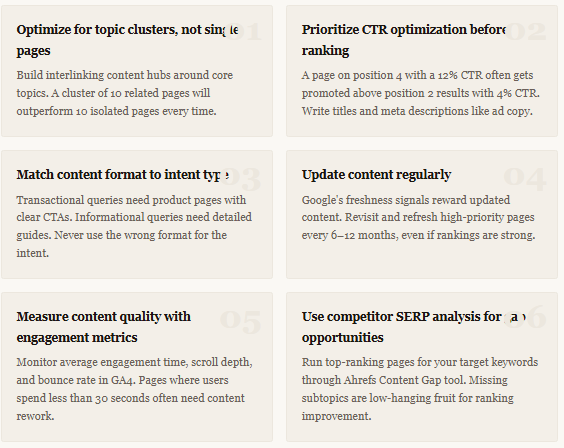
Common Mistakes to Avoid in On-Page SEO Services
- Keyword stuffing: Forcing a keyword into every sentence destroys readability and triggers Google’s spam filters. Natural placement, contextual usage, and semantic variation always outperform repetition.
- Ignoring search intent: Optimizing a page for a transactional keyword but publishing informational content (or vice versa) means the page will never rank regardless of how technically perfect it is.
- Using the same title tag across multiple pages: Duplicate title tags are a crawl-efficiency problem and prevent each page from being positioned around its own unique keyword target.
- Neglecting mobile optimization: With Google’s mobile-first indexing fully in place since 2023, a page that performs poorly on mobile devices is indexed and ranked based on its mobile version — even for desktop users.
- Treating on-page SEO as a one-time task: Competitor pages are constantly updated, search intent evolves, and algorithm changes shift what Google rewards. On-page optimization is ongoing, not a checkbox.
- Overlooking Core Web Vitals: LCP (Largest Contentful Paint), INP (Interaction to Next Paint), and CLS (Cumulative Layout Shift) are Google ranking signals since 2021. Poor scores actively suppress rankings for otherwise well-optimized pages.
- Missing internal links to new content: Publishing a new page without linking to it from existing high-authority pages leaves it orphaned — Google may not discover or index it for weeks or months.
Conclusion — Execute On-Page SEO as a System, Not a Checklist
Providing on-page SEO services that produce lasting, measurable results requires treating every element — from title tags to structured data to internal linking — as part of an interconnected system. No single optimization exists in isolation. A perfect title tag on thin content will not rank. Exceptional content behind a poor URL structure and missing schema will underperform. The professionals who consistently deliver results for clients are those who understand how every on-page signal works together, not just in isolation.
Start every engagement with a thorough audit. Build your optimization strategy around verified search intent. Write and structure content that genuinely serves the user. Implement technical markup that helps search engines understand context. Measure results, revisit the work, and refine continuously. On-page SEO is not a one-time project — it is an ongoing practice that compounds in value over time. The clients who trust you with this work deserve a practitioner who treats it that way.
FAQs About On-Page SEO Services
What is included in on-page SEO services?
On-page SEO services typically include keyword research and mapping, title tag and meta description optimization, heading structure review, content writing or rewriting, image alt text optimization, URL structure improvements, internal linking strategy, structured data (schema) implementation, and Core Web Vitals assessment. The scope varies by provider and package, but these elements form the standard foundation of any professional on-page engagement.
How long does on-page SEO take to show results?
Most on-page SEO improvements begin showing measurable movement in search rankings within 4 to 12 weeks, depending on the site’s current authority, the competitiveness of target keywords, and the scale of changes made. Quick wins — such as fixing missing title tags, correcting heading structure, and adding FAQ schema — can produce results faster, sometimes within 2 to 4 weeks. Comprehensive content overhauls typically take longer to fully reflect in rankings.
What is the difference between on-page and off-page SEO?
On-page SEO refers to optimizations made directly on the website — content, tags, structure, and technical markup — all of which are within your direct control. Off-page SEO refers to external signals that influence rankings, primarily backlinks (other sites linking to yours), brand mentions, social signals, and local citations. Both are necessary for a competitive ranking strategy, but on-page SEO is always the prerequisite: it is pointless to build backlinks to a poorly optimized page.
How do I price on-page SEO services for clients?
On-page SEO services are typically priced based on the number of pages optimized, the depth of work per page, and whether content creation is included. Common pricing structures include a per-page rate ($150–$500 per page for audit + optimization), a monthly retainer for ongoing optimization ($500–$3,000/month depending on site size), or a project-based flat fee for a one-time audit and implementation. Factors that justify higher pricing include competitive niches, content creation scope, and schema markup implementation.
Can on-page SEO alone improve rankings without link building?
Yes — in many cases, particularly for low to moderately competitive keywords, on-page SEO optimization alone is sufficient to achieve strong rankings. For brand new domains or highly competitive industries, building backlinks alongside on-page optimization is necessary to compete. However, for local businesses, niche service providers, and established domains with existing authority, aggressive on-page optimization consistently produces ranking improvements without additional link building efforts.