
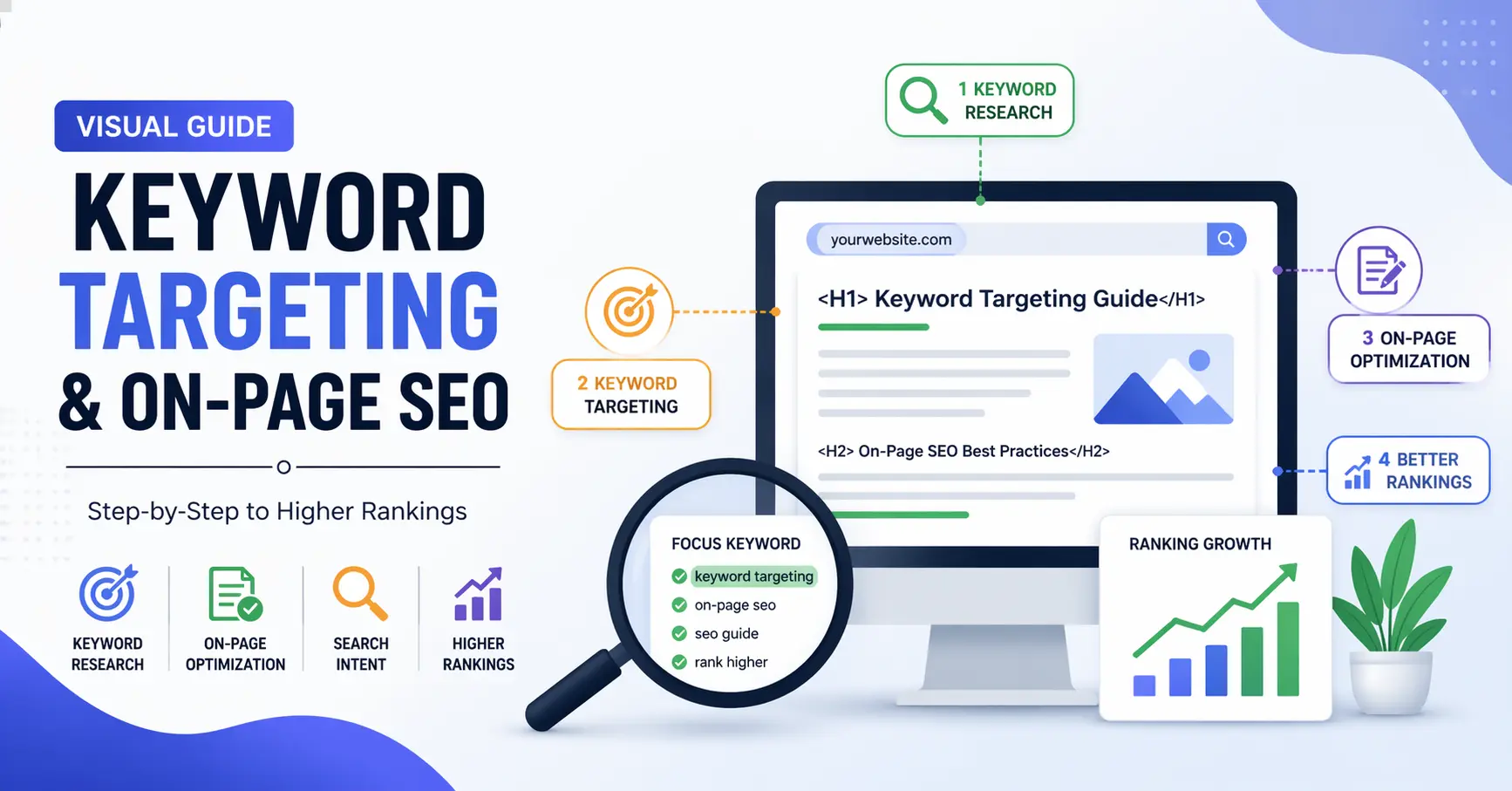
Keyword targeting and on-page SEO are the backbone of ranking any content on search engines. If you’re new, first understand the basics in our guide on What is SEO and how it works.. If your keywords are wrong or poorly placed, even high-quality content won’t perform well in search results.
Most beginners make the same mistake they either pick keywords that are too competitive, or they stuff keywords unnaturally into content. Both approaches fail.
This visual guide to keyword targeting and on-page SEO explains how to rank content effectively on search engines. You’ll learn how to choose the right keywords, understand user intent, and place keywords correctly across your page for maximum SEO impact — all explained with real examples, practical tips, and clear visuals.
What is Keyword Targeting (Visual Understanding)
Keyword targeting means selecting and using specific search terms that match what users are looking for. It’s not just about picking high-volume keywords — it’s about relevance, intent, and structure working together.
Think of it this way: Google is not just reading your content, it’s understanding the topic you’re covering. So your job is to signal that topic clearly through strategic keyword usage.
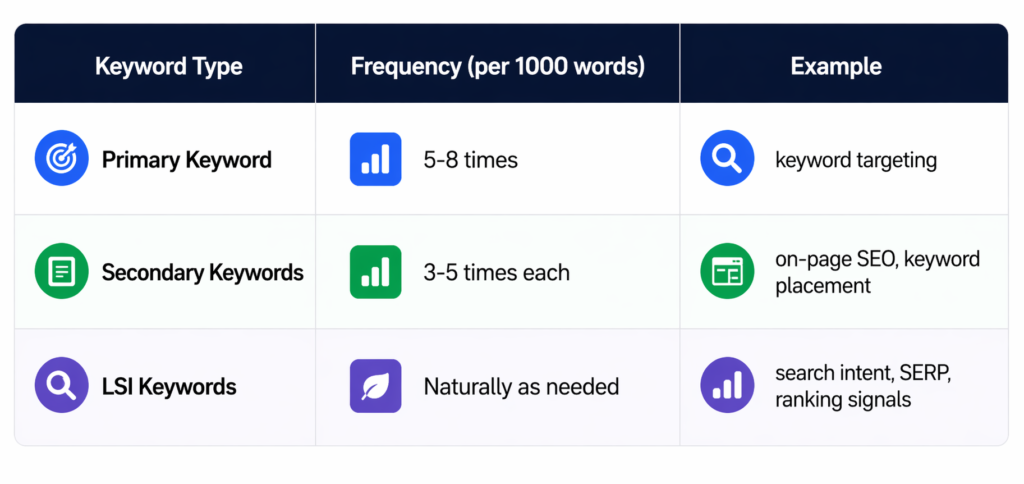
A well-optimized page usually includes:
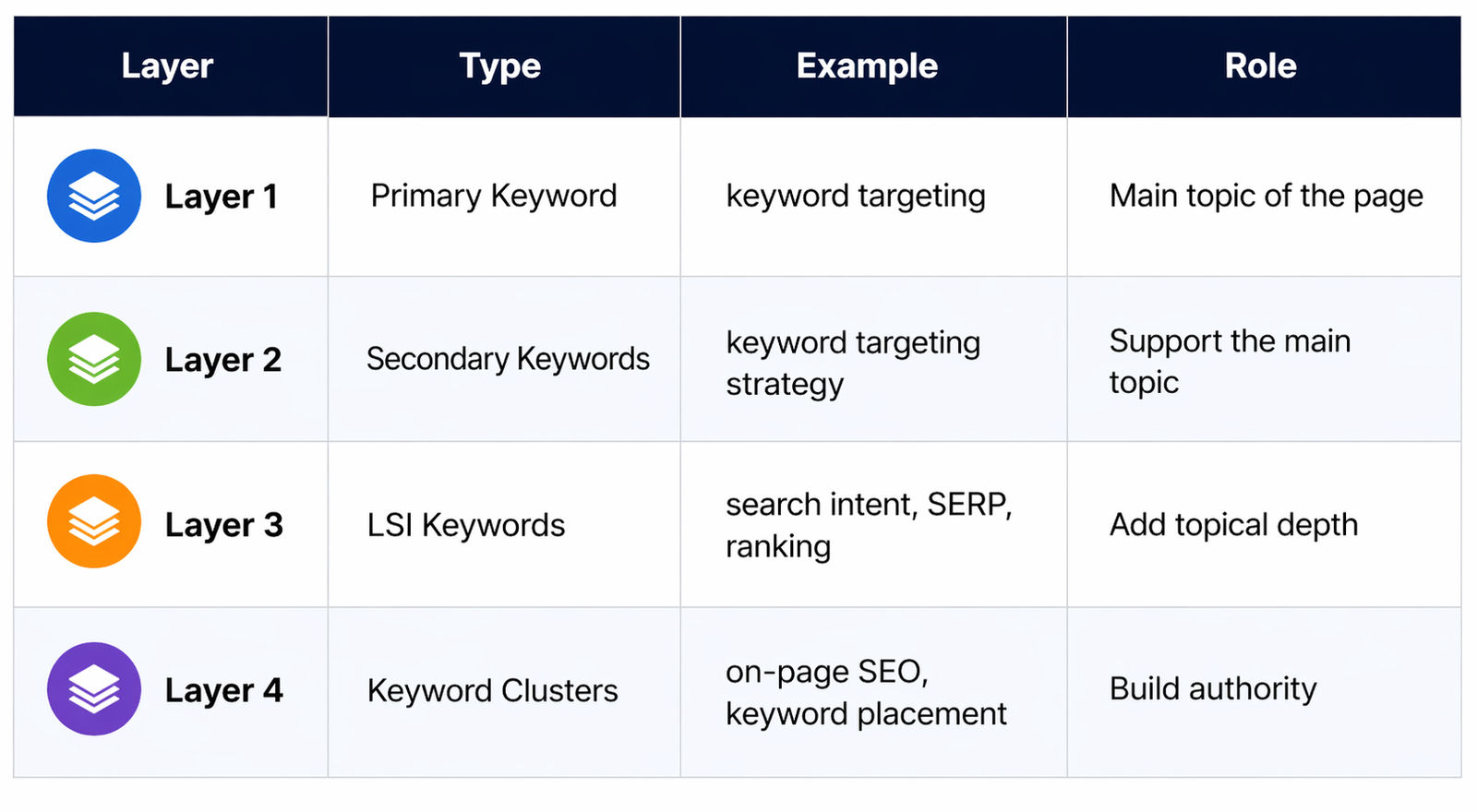
For example, if your primary keyword is keyword targeting, your cluster may include:
- keyword research strategy
- SEO keyword placement
- on-page SEO optimization
- search intent analysis
- keyword density best practices
This creates topical depth, which search engines prefer.
Understanding Search Intent (Core of Targeting)
Before placing any keyword, you must understand why someone is searching for it. This is called search intent — and it’s the most important factor in modern SEO.
If your content doesn’t match the user’s intent, Google will NOT rank it — no matter how well optimized it is. This is where most beginners fail.
There are 4 main types:
- Informational – user wants knowledge
- Navigational – user looks for a specific site
- Transactional – user wants to buy
- Commercial – user compares options
For this topic — keyword targeting and on-page SEO — the intent is informational + learning. So your content must be:
- Detailed and educational — not sales-focused
- Well-structured with clear headings
- Backed by examples and visuals
- Answer all related questions the user might have
How to Find the Right Keywords
Start with Seed Keywords
A seed keyword is a broad term related to your topic. Start simple:
- on-page SEO
- keyword research
- SEO optimization
- search engine ranking
Expand Using Tools
Use tools like keyword research platforms to find:
- Search volume
- Keyword difficulty
- Variations
Look for keywords with medium volume + low competition.
Build Keyword Clusters
Instead of writing multiple thin articles, create one strong, comprehensive page covering all related queries under one topic.
Example cluster for this article:
- keyword targeting (primary)
- keyword placement SEO (secondary)
- how to use keywords in blog post (secondary)
- what is search intent in SEO (LSI)
- on-page SEO checklist (cluster article)
This improves topical authority.
Analyze the SERP Before Finalizing
Before confirming any keyword, Google it manually and check:
- What type of content is ranking? (guide, listicle, video?)
- What’s the word count of top results? (aim to match or exceed)
- Are there featured snippets? (structured content can win these)
- Is the SERP dominated by big brands? (if yes, pick a different keyword)
Visual Guide to On-Page SEO Placement
On-page SEO is about placing keywords strategically across your page so that search engines clearly understand your topic — without making the content feel unnatural or forced.
Think of your page as a map. Every section sends signals to Google. Here’s exactly where to place keywords and why each location matters:
Key Placement Areas:
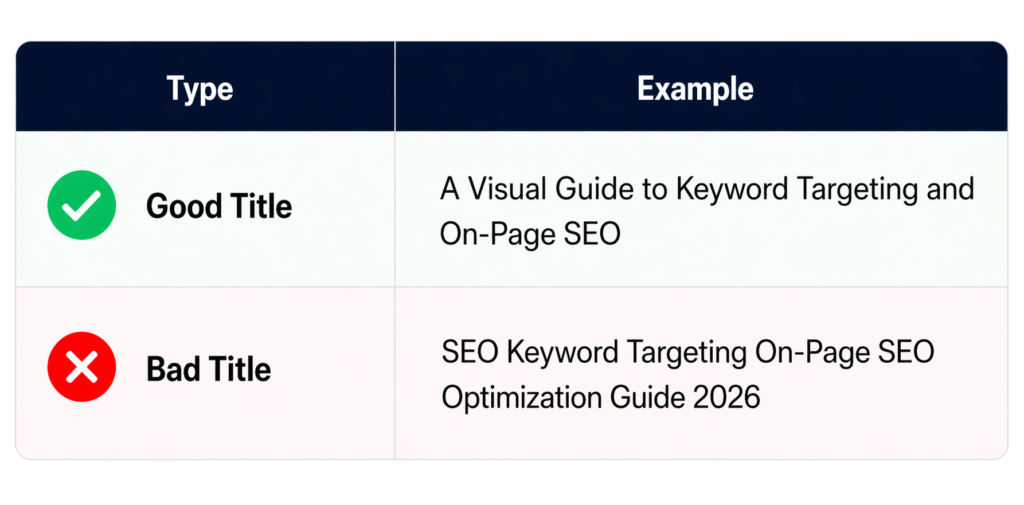
1. Title (H1)
Your primary keyword must appear naturally in the title. This is the strongest on-page signal.
2. Meta Title & Description
These appear in search results. Your meta title should include the primary keyword early (within first 60 characters). The meta description should mention the keyword naturally and include a clear benefit or call to action.
- Meta Title: A Visual Guide to Keyword Targeting and On-Page SEO (2026)
- Meta Description: Learn how to choose the right keywords and place them correctly for maximum rankings. Includes visual examples and a step-by-step on-page SEO checklist
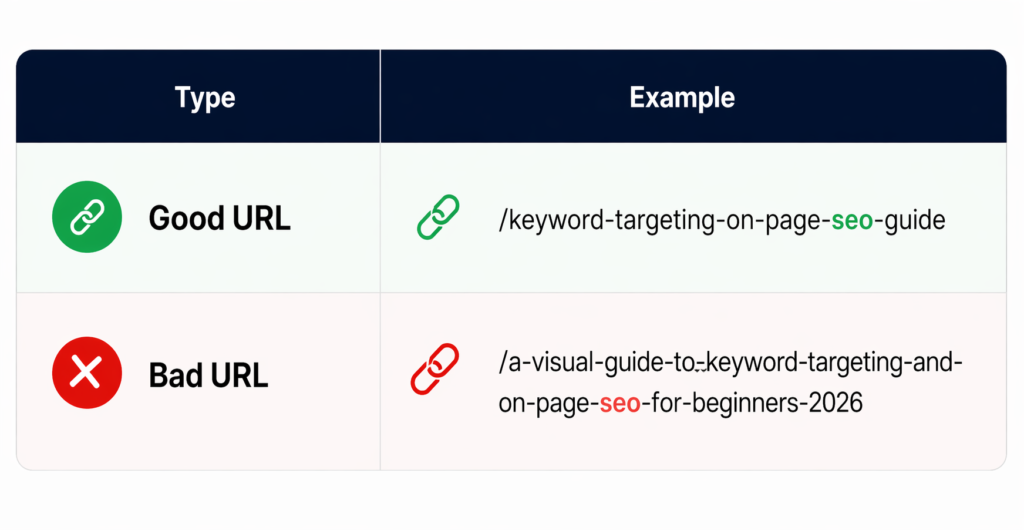
3. URL Slug
Keep it short and keyword-focused.
4. First 100 Words
Search engines give extra importance to the opening paragraph. Your primary keyword should appear naturally within the first 100 words. Don’t force it — just make sure it’s there.
5. Headings (H2, H3)
Headings structure your content and signal sub-topics to Google. Use secondary and LSI keywords in your H2s and H3s — not the same primary keyword repeatedly.
- H2: What is Keyword Targeting in SEO?
- H2: How to Find the Right Keywords
- H3: Understanding Search Intent
- H3: Building Keyword Clusters
6. Content Body
There is no perfect keyword density number. The goal is natural usage. A safe range is 1-2% — meaning your primary keyword appears roughly once every 100-200 words.
More importantly, use variations and synonyms. Google understands semantic meaning, so ‘keyword targeting’, ‘keyword optimization’, and ‘keyword strategy’ all reinforce the same topic.
7. Image Alt Text
Search engines cannot see images — they read the alt text. Every image should have a descriptive alt text that includes a relevant keyword where it makes sense.
- Good: alt=’keyword targeting diagram showing primary and secondary keywords’
- Bad: alt=’image1′ or alt=’SEO keyword targeting on-page optimization diagram screenshot’
8. Internal Links
Internal links connect your pages and help Google understand your site structure. When you mention a related topic, link to your other article on that topic using keyword-rich anchor text.
- Good anchor: ‘learn more about search intent optimization’
- Bad anchor: ‘click here’ or ‘read more’
Content Optimization Strategy
Content is not just about keywords—it’s about depth + clarity + structure.
To optimize properly:
- Cover the topic completely
- Answer related questions
- Use simple explanations
- Add examples and comparisons
- Be structured logically — intro, sections, conclusion, FAQ
Google prefers content that satisfies user intent fully, not just partially.
The E-E-A-T Factor
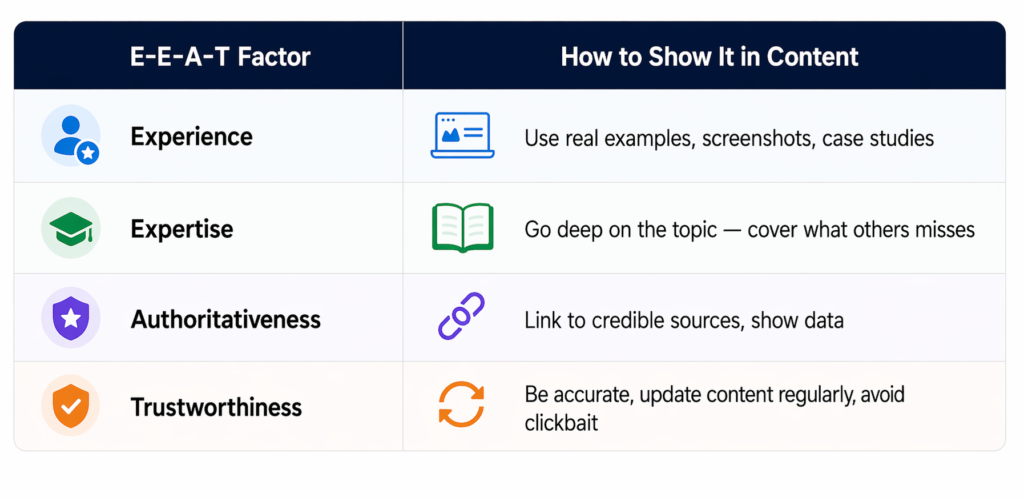
Google evaluates content quality using E-E-A-T — Experience, Expertise, Authoritativeness, and Trustworthiness. In practice, this means your content should reflect real experience with the topic, not just theoretical knowledge. Cite credible sources, link to authoritative references, and ensure your author bio clearly establishes your background in SEO. Pages that demonstrate genuine expertise and transparency consistently outperform thin, uncredited content in search results.
Example of Perfect Keyword Placement
Let’s say your keyword is: “keyword targeting”
Proper usage:
- Title: A Visual Guide to Keyword Targeting
- Intro: mention within first paragraph
- H2: What is Keyword Targeting
- Body: naturally repeated with variations
- Alt text: keyword targeting diagram
Wrong usage:
- Repeating keyword 20+ times unnaturally
- Stuffing keywords in every sentence
- Ignoring context and readability
Expert Tips for Better Rankings
- Focus on topic coverage, not just one keyword
- Use semantic keywords instead of repetition
- Keep paragraphs readable and structured
- Add visuals to increase engagement
- Optimize for user experience, not just search engines
Consistency in structure and clarity often beats aggressive keyword usage.
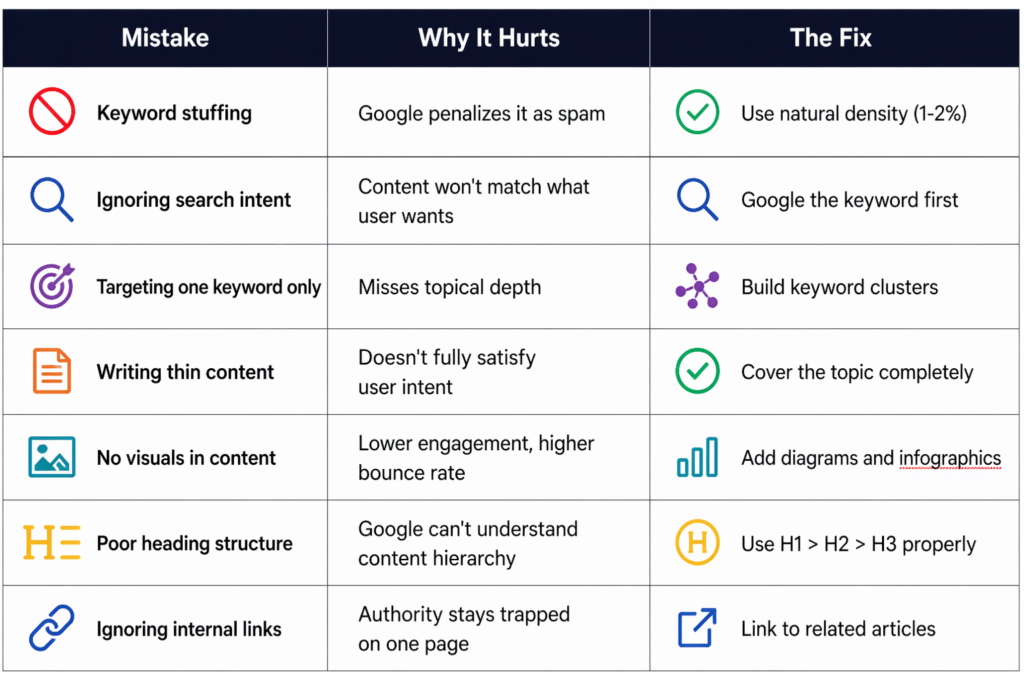
Common Mistakes to Avoid
These mistakes are extremely common — especially among beginners. Avoiding them alone can significantly improve your rankings:
Want a detailed explanation of each mistake? Read our complete guide on SEO mistakes.
On-Page SEO Quick Checklist
Before publishing any article, run through this checklist:
- Primary keyword in H1 title
- Primary keyword in first 100 words
- Primary keyword in meta title and description
- Short, keyword-focused URL slug
- Secondary keywords in H2 and H3 headings
- Natural keyword usage throughout body (1-2%)
- All images have descriptive alt text
- At least 2-3 internal links to related content
- Content fully covers the topic (no major questions left unanswered)
- Content matches search intent of target keyword
- Visuals added to support key concepts
Conclusion
Keyword targeting and on-page SEO work together to define your content’s success. When you choose the right keywords, understand intent, and place them strategically across your page, your chances of ranking increase significantly.
Focus on clarity, depth, and structure—not shortcuts. SEO is not about tricking search engines; it’s about aligning your content with what users truly need.
FAQs
What is keyword targeting in SEO?
Keyword targeting is the process of selecting and optimizing specific keywords in your content to match what users are searching for. It involves choosing the right primary keyword, building a supporting cluster, and placing keywords strategically across the page.
How many keywords should I use in one article?
Use one primary keyword as your main focus, then add 3-5 secondary keywords and multiple LSI (contextually related) keywords throughout the content. There’s no fixed number — the goal is natural, relevant usage.
What is ideal keyword density?
There’s no officially confirmed perfect number, but 1-2% is considered safe and effective. For a 1,000-word article, that means your primary keyword appears roughly 10-20 times. Quality and relevance matter more than hitting a specific number.
Where should I place keywords?
The highest-impact locations are: H1 title, first 100 words of introduction, meta title and description, URL slug, H2/H3 headings, image alt text, and naturally throughout the content body.
Is keyword stuffing harmful?
Yes — keyword stuffing is a confirmed negative ranking factor. It makes content unreadable, triggers Google’s spam filters, and can result in manual penalties. Always prioritize readability over keyword frequency.
How do I know if my keyword is too competitive?
Check the Keyword Difficulty (KD) score in tools like Semrush or Ahrefs. For new blogs, target keywords with KD 0-30. Also manually Google the keyword — if top results are all from major brands with thousands of backlinks, pick a more specific long-tail variation instead.
What is the difference between on-page and off-page SEO?
On-page SEO refers to everything you control on your own page — keywords, content quality, headings, meta tags, URL structure, and internal links. Off-page SEO refers to external signals — primarily backlinks from other websites, which build your domain authority over time. Both are essential for ranking.